

Motorcycle Tyre Wear Patterns Explained How to Read TWI and Spot Ride or Maintenance Issues

A motorcycle tyre tells on you. It shows where you brake hard, how often you corner, whether your pressures are right, and whether the bike’s suspension or alignment needs attention. The trick is knowing what you’re looking at before the tyre becomes unsafe.
Tyres are your only contact patches with the road, each roughly the size of a small handprint. On wet Singapore roads, worn tread has less space to move water away, so grip can drop fast. A quick tyre read before a ride can save money, improve handling, and help you catch maintenance issues early.

How to read a motorcycle tyre like a mechanic
Start by looking at three zones:
Left shoulder Centre strip Right shoulder
\ | /
\ | /
\______________ _|________________/
The centre strip shows straight-line riding, throttle use, and tyre pressure habits. The shoulders show cornering load, lean angle, and suspension behaviour. The grooves show water clearance and remaining tread depth.
Check both tyres, but don’t expect them to wear the same. The rear tyre usually wears faster because it handles drive force. The front tyre often shows braking wear, cupping, or uneven edges because it carries load during braking and steering.
Do this simple check:
Park the bike upright on level ground.
Rotate each wheel slowly.
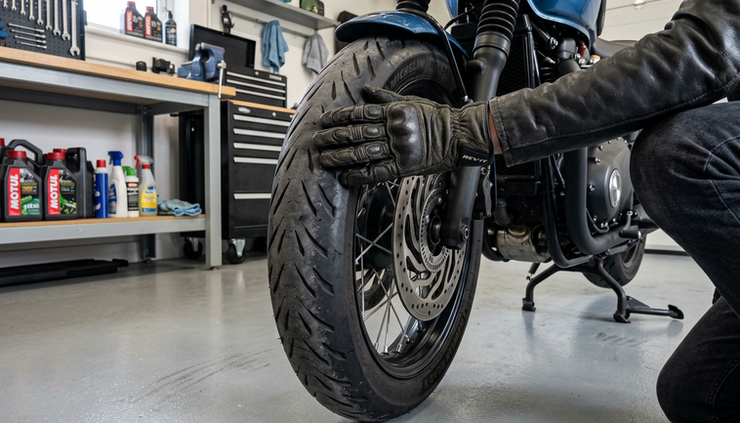
Look for wear bands, cracks, cuts, flat spots, nails, bulges, and exposed cords.
Run your palm lightly over the tread.
Compare both sides of the tyre.
That hand check matters. Some uneven wear is easier to feel than see.
Common tyre wear patterns and what they mean
Wear pattern | What you’ll see | Common causes | What it may say |
Centre wear | Middle tread is flatter than the shoulders | Long highway rides, hard acceleration, overinflation, normal rear tyre wear | Lots of straight-line riding or pressure too high |
Shoulder wear | Edges wear faster than the middle | Frequent cornering, spirited riding, track use, low pressure | Aggressive lean angles or underinflation |
Cupping or scalloping | Alternating high and low patches around the tyre | Worn suspension, poor wheel balance, hard braking, low pressure | The tyre is bouncing instead of tracking smoothly |
One-sided wear | One shoulder is more worn than the other | Misalignment, bent parts, road camber, uneven loading | Bike may not be tracking straight |
Flat spot | One area is worn flat | Emergency braking, locked wheel, long storage in one position | Grip and balance may be affected |
Feathering | Tread blocks feel sharp one way and smooth the other | Incorrect pressure, alignment issue, aggressive braking or cornering | Tyre is being scrubbed across the road |

What pressure-related wear looks like
Pressure is one of the biggest causes of odd tyre wear, and it’s also one of the easiest things to fix.
Overinflation tends to wear the centre faster. The tyre becomes more rounded, so the middle does more work. The bike may feel nervous over bumps, with less contact patch on the road.
Underinflation often wears the shoulders faster. The tyre flexes more, builds extra heat, and can feel heavy when turning. Heat is a serious issue because tyres are designed to work within a pressure and load range set by the manufacturer.
Here’s the quick visual:
Overinflated
___
__/ \__
/ \
Centre wears faster
Underinflated
__ __
/ \_____/ \
Shoulders wear faster
Check pressures when the tyres are cold. Riding heats the air inside the tyre, which raises the pressure reading. Use the bike maker’s recommended pressure for normal riding, luggage, or pillion use.
What riding style leaves behind
Tyre wear isn’t always a “problem”. Sometimes it’s just a record of the ride.
A commuter doing mostly expressway kilometres will often square off the rear tyre. That means the centre gets flat while the shoulders still have tread. The bike may start to resist leaning, then drop into turns once it passes the squared edge.
A rider who enjoys twisty roads may wear the shoulders evenly. That’s fine if the tread depth is still safe and the wear is smooth. Rough, torn, or patchy shoulder wear can mean pressure is wrong, suspension damping is off, or the tyre is being overheated.
A front tyre with cupping can point to repeated hard braking, worn fork components, imbalance, or pressure that’s been left too low for too long. If the handlebar shakes, the tyre hums, or the bike feels vague mid-corner, don’t ignore it.
Why Tread Wear Indicators matter (TWI)
Tread Wear Indicators, or TWI, are small raised bars moulded into the grooves of the tyre. You’ll usually find them by looking for a tiny triangle, arrow, or `TWI` marking on the tyre sidewall. Follow that mark into the tread groove and you’ll see the wear bar.
When the tread surface becomes level with the TWI bar, the tyre has reached its wear limit at that point. That’s not a “ride for another month” sign. It means the tyre can no longer clear water or grip as designed.
Check TWI in several places around the tyre. A tyre can be legal-looking in one section and worn out in another, especially if it has cupping, a flat spot, or one-sided wear.
Many tyre makers place TWI bars at or near the minimum safe tread depth used in road rules. In Singapore, wet roads and sudden rain make this even more important. Once the tyre is near the bars, plan a replacement rather than waiting for the bars to fully disappear into the tread surface.
Maintenance clues hiding in the wear
Tyre wear can also point to bike issues:
Repeated cupping
Check suspension, wheel balance, steering bearings, and tyre pressure.
Fast rear centre wear
Check pressure habits, throttle use, load, and whether the tyre suits your riding mix.
Wear on one side
Check wheel alignment, swingarm condition, fork alignment, and whether the bike has been dropped or repaired badly.
Cracks or hard rubber
Age, heat, and sun exposure can dry out rubber even when tread remains.
Bulges or exposed cords
Stop riding and replace the tyre. That’s structural damage.
If you’re unsure, get the tyre inspected. A Mobile Mechanic can often identify whether the issue is just tyre age or something else like a worn shock, loose bearing, or poor wheel balance.

When to replace the tyre
Replace the tyre when any of these show up:
Tread is level with the TWI.
Wear is uneven enough to affect handling.
There are cuts, bulges, cracks, or exposed cords.
The tyre keeps losing pressure.
The bike vibrates after balancing or inspection.
The rubber has hardened with age and feels slippery in normal riding.
For riders who can’t safely ride to a workshop, Onsite Tyre Replacement can be a practical option, especially if the tyre is punctured, badly worn, or showing damage.
The best habit is simple: check pressure weekly, inspect tread before longer rides, and read the wear pattern instead of just glancing at the tyre. Smooth, even wear means the bike, tyre, and riding style are working well together. Odd wear is your early warning. Catch it early, and the ride stays safer, sharper, and a lot more predictable.


Comments